
The Mysterious Disappearance of Sweet Betsy
“[S]ome gardeners swear they have one of the most pleasing garden fragrances on the planet…” —L.A. Jackson.
It’s late August, and the landscapes in my world are still green and fecund, yet the air hints of change: from summer break to a return to school, from hot days to coolish nights, from one season of life to another. As I walk my family’s North Carolina farm, I encounter nature thriving and reproducing, including plants like thorny green briar or itch-provoking Virginia creeper, requiring pruning and vigilance, as discussed here.
What’s Missing in the Landscape
What I no longer observe, but wish I did, is one special plant, a sweet Betsy bush I loved as a child and for decades beyond. Each spring, I looked forward to the arrival of maroon buds that opened in layers to emit a sweet, spicy fragrance reminiscent of nectar and cinnamon. That bush has since disappeared, leaving no trace.
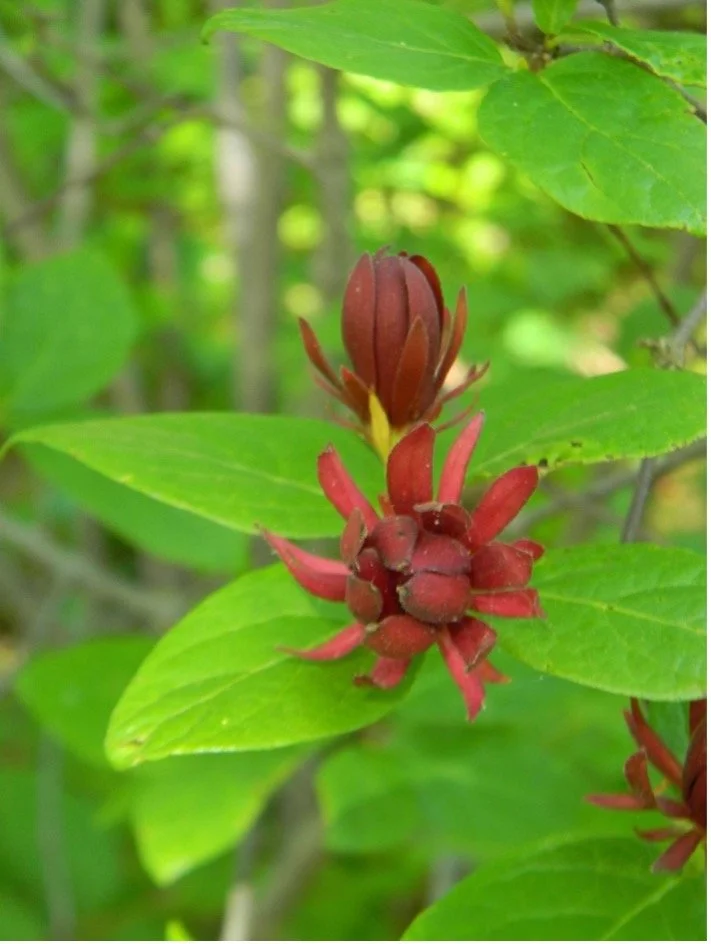
Photo: Randy Harder, Buncombe County, NC. NC Extension Gardener Plant Toolbox
Calycanthus floridus is also called Carolina allspice and sweet shrub, but my family has only known it as sweet Betsy. It is a rounded, deciduous shrub, native to the Southeastern United States but rarely observed in gardens today.
Our sweet Betsy grew about eight feet high and ten feet wide and stood for years beneath the shade of a giant holly tree. The holly and the sweet Betsy flourished near what we call the old house, a somewhat dilapidated 1860 farmhouse, a staunch relic currently undergoing repairs for preservation.
My siblings and I often wandered to the sweet Betsy bush to admire its rust-colored flowers and smell its one-of-a-kind scent. When I asked my siblings recently to describe sweet Betsy’s aroma, they could think of nothing that compares to the bush’s “sweetest sweet smell,” a phrase coined by my sister.
I have no knowledge of who planted that sweet Betsy bush long ago. My grandfather acquired the property from his father in 1900 and lived in the house near where the bush grew. Letters from my grandmother to my grandfather before their marriage show her admiration of the beautiful shrubs, trees, and flowers surrounding the home of the man she loved. She doesn’t mention sweet Betsy specifically, but it could well have been thriving there before their nuptials in 1914, when she moved into the house with her new husband and they became parents to my father and later to my uncle.
Unlike people, sweet Betsy bushes have no fixed lifespan. They are among the long-lived perennials that can survive for decades or even centuries. In theory, they could live forever because they constantly renew themselves by producing new plants.
Mystery of Missing Sweet Betsy
But also like people, this sweet Betsy bush proved to be mortal. When I researched potential causes of its demise, I learned that even long-life perennials succumb to aging, disease, and environmental stress, including drought, flash freezes, voles, or deep shade. Their cells can age and degrade. Although they replicate themselves through root systems that create new plants, eventually those systems can fail.
I am unable to determine the actual cause of death or even the year of death of this sweet Betsy. It faded away quietly, without immediate notice. The growing canopy of the holly tree may have been the culprit, preventing photosynthesis and depleting the sweet Betsy’s life force. Perhaps voles damaged its roots, as they dug underground paths that crisscrossed the yard one year. Or maybe its cells aged and could no longer support life.
Memories of Sweet Betsy’s Scent
What I do know is that the bush’s fragrance stands out prominently in my olfactory memory. Scents carry emotional weight, as described in Harvard Medicine. Recalling sweet Betsy’s fragrance evokes nostalgia and delight for my siblings and me, prompting memories of warm spring and summer days of our youth.
Like so much from the past, I regret the loss of the sweet Betsy bush and have never known anyone else who has one. Nevertheless, I look forward to finding and establishing a new sweet Betsy bush on the farm in a suitable location with partial shade. If I succeed, it will survive me and live far into the future to exhale its perfume for generations to enjoy.
