
Making the Cut: Pruning Foliage and Invasive Plants
The Ripeness of Summer on a Farm
“Nature abhors a vacuum” is an idea attributed to Aristotle and a truth I can attest to. No sooner do I clear brush and weeds than they reappear, defying my efforts.
When I returned to the family farm in July, the lushness of the peak growth season showed just how much outdoor work needed to be done. The sweltering July heat caused me to be selective with any outdoor jobs I could accomplish.
As steward of the farm, I am tasked with pruning and cutting back trees and bushes, many of which grow of their own volition near the modest homestead, barns, and roadside. What start as innocent saplings, barely noticed, grow quickly and spread through shoots or dispersal of seeds by the plants or birds. On occasion, I have hired arborists and brush whackers for assistance.
Pruning Foliage and Tackling Invasive Plants
Increasingly, many of the new plants and young trees cropping up are invasive species. Excess foliage of even desirable plants must be pruned, but the more I learn, the more alarmed I am at how aggressive invasive species can be. The farmhouse yard had both problems—limbs in need of removal and invasive plants emerging and thriving.
With help from a trusted friend, we researched and purchased a universal blade for a reciprocating saw (3 teeth per inch) for pruning small-diameter limbs. Armed with my brother’s battery-powered saw and my pruning loppers and wearing protective gloves and clothing, we addressed an assortment of foliage over several very hot days:
We sawed overhanging limbs from an invasive Chinaberry tree above a low roofline of the farm residence. The branches seemed to have become a menace in just months. When I was a child, my aunt and uncle had a Chinaberry tree shading a swing set I played on, and I recall sniffed its pungent berries. Now I know this species is invasive.
We cut and lopped foliage, including pine, sassafras, and oak branches, that protruded by the roadside and prevented a clear view of oncoming traffic from the driveway. While these trees are native to North Carolina and not invasive, they must be managed for safety.
We tackled a large patch of invasive privet spreading in an area of the yard where an apple tree once dropped fruit gathered by my mother to make apple jelly and apple sauce. Amidst the privet, I spotted the dead trunk of the apple tree, perhaps robbed of life by the spreading privet. A low bushy tree that grows near wetlands or in bottomlands, the most prevalent variety in my area is Ligustrum sinense or Chinese privet. It is ranked by the North Carolina Native Plant Society as one of the most severe threats of invasive non-native plant species in the State because it spreads rapidly, takes over forest floors, and crowds out native plants.
After lopping and sawing, we piled branches free of seeds into the bed of my brother’s red pick-up and hauled several loads to an out-of-the-way area of woods. There, the foliage will deteriorate into mulch and become part of the soil again.
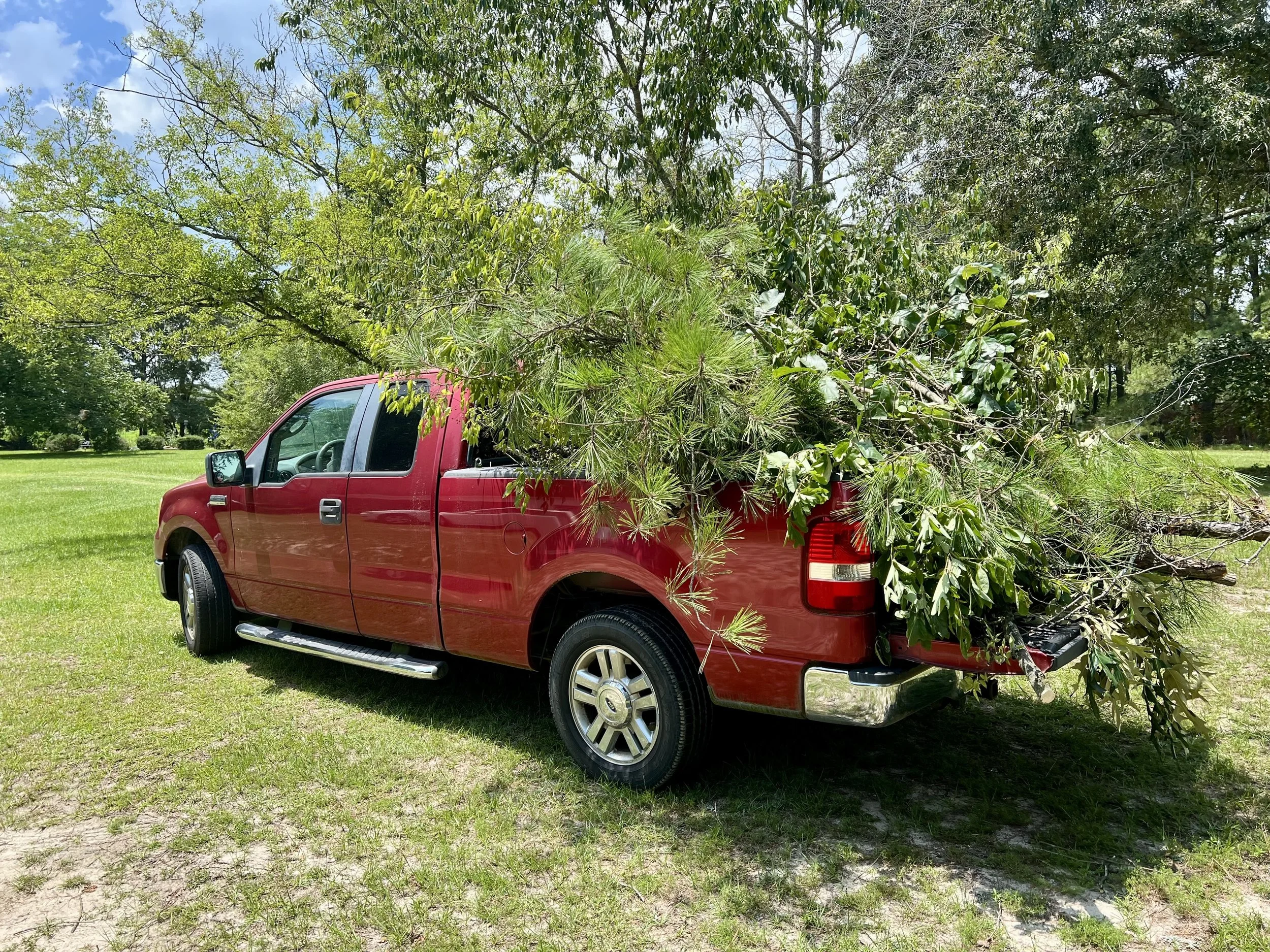
Ready to Haul One of Several Loads of Pruned Foliage
Stewarding Equals Worry
Taking care of the family farm is a privilege that is not always a joy. I worry about each problem and try to find solutions before challenges become worse. Nature changes constantly, and I must adapt and be vigilant, conduct research, and continue striving to maintain and protect the farm, its inhabitants and habitats, and the environment.
The heat of summer is not an ideal pruning time, but I made considerable progress as I worked, sweat dripping. Nevertheless, much remains to be done. I will contend with more foliage and invasive plants in a cooler season, when the greenery dies back and can be more easily addressed.
