
Smashing Southern Stereotypes
As the Spring farming season begins, I’ve been thinking about what growing up in the rural South means for me, then and now. When Jason DeFord, also known as Jelly Roll, recently called himself a “dumb redneck” at the 2026 Grammy’s, his self-deprecation prompted me to reflect on Southern stereotypes, something I’ve pondered through the years.
Erskine Caldwell and Southern Stereotypes
In the late 1970s, in a Southern literature course at North Carolina State University, I encountered Erskine Caldwell’s 1932 novel Tobacco Road. Whatever Caldwell’s intent, his characters embody the Southern stereotype of “poor white trash” with the emphasis on trash. I recall feeling shocked, indignant even. I had grown up laboring in tobacco fields, poor and white, but I knew I wasn’t trash. I didn’t know then that Caldwell’s novel had stirred controversy for suggesting that poverty erodes morals and ethics, including a work ethic. Had I known, I would have been even more incensed because I know that poverty wears down one’s spirit and self-esteem, not morals and ethics. Those can be dissipated by wealth as much or more as by poverty.
Despite recurring tropes and characterizations, the Southern United States is not inherently disfigured and grotesque, nor is it inhabited especially by racist, idle, or unaware hicks. Yet the stereotype of Southerners as stupid, lazy, and ignorant continues to be bandied about consciously and unconsciously.
Having grown up in a family with few financial resources, I know the poor are financially strapped, struggling human beings often ridiculed and judged for lack of money. Poverty isn’t specific to race or ethnicity and often runs through generations, perpetuated without education, resources, and programs to assist and encourage a climb out of the poorhouse.
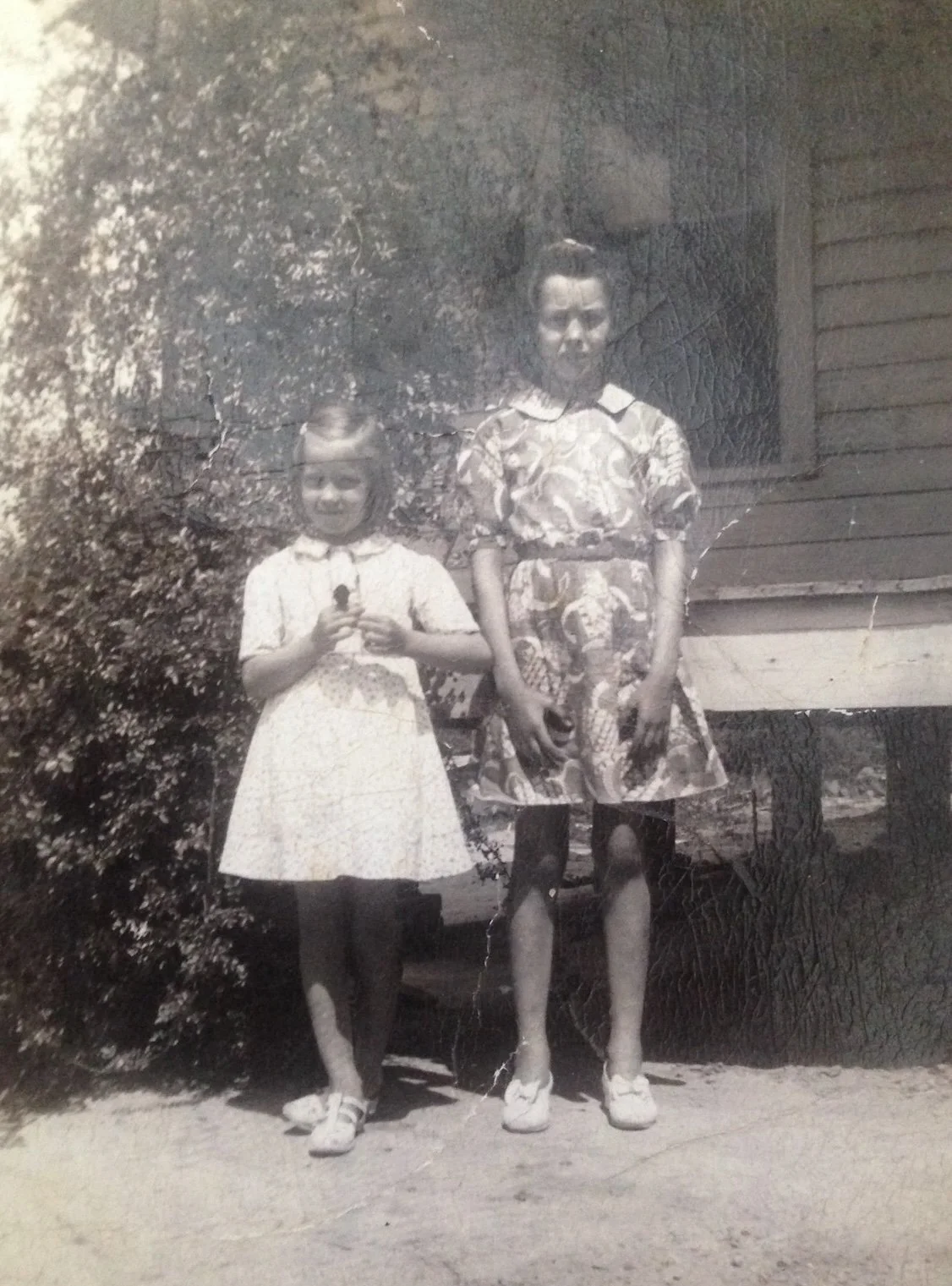
My aunts as children, circa 1940.
Experiencing Southern Stereotypes Firsthand
I was in my mid-thirties when I first visited the Northern United States. I did not define myself as a Southerner but considered myself a native North Carolinian. Only when I moved to Pennsylvania for work as an English professor did I realize how entrenched negative stereotypes about the South can be for many non-Southerners.
My naivety regarding my standing in a Northern state exploded with an essay assignment I gave in English composition classes. The assignment asked students to “write about one of your personal traits or characteristics that tells others something about yourself.” In class, I used my accent as an example and asked students to brainstorm possible meanings they might attribute to the way I speak. Perhaps I was curious. They apparently relished the opportunity. As I scrawled their responses in chalk on the front blackboard, I was stunned at the focus on stereotypes being attributed to me: racism, lack of intelligence, weakness.
My Southern Identity Crisis
That day, I experienced a turning point in my thinking about my identity. I felt as if someone had thrown rotten tomatoes and ice water on me, waking me up with a start. I had wondered why some students seemed disrespectful. Maybe the attitude is because I am a woman, I thought, or maybe I am too soft spoken, not authoritative enough. That my accent signaling my Southern origins could play a role had never occurred to me. Now I realized that some people harbor prejudices against Southerners based on nothing more than whether someone speaks with a twang.
My accent is slight but detectable, enough so that after being a displaced Southerner for over three decades, complete strangers will occasionally ask, “Where are you from?” The question, probably asked innocently enough, continues to catch me by surprise because I don’t often think about how I talk. I don’t try to filter out “y’all,” but I admit to hesitating when pronouncing “fire” to make sure I don’t say something akin to “fair.”
Still, I know Southern stereotypes exist and are hard to shatter. I find myself sometimes feeling apologetic that I was born and raised in the South, despite feeling proud that my heart and feet still wander and protect North Carolina fields and woods. Yet I know any ambivalence stems from concerns based in stereotypes.
The Changing South and Smashing Stereotypes
It’s true that the South is changing. Its generally temperate climate attracts people wanting to escape the cold North for what they think will be a more easeful lifestyle. As a region, the South is at a crossroads, losing farmland, traditions, and simple values at an exorbitant cost to the environment, agriculture, and local communities. It is being reshaped by various forces, external and internal.
Perhaps negative Southern stereotypes will change as well, ushering in a recognition that the South is a region on a map, that being poor and unprivileged, no matter who or where, means only that someone faces dire financial stress. What’s most important is creating opportunities and support for escaping cycles of poverty. In the process, perhaps we can smash harmful stereotypes that serve centuries-old power dynamics that insists that someone is better than someone else.
